
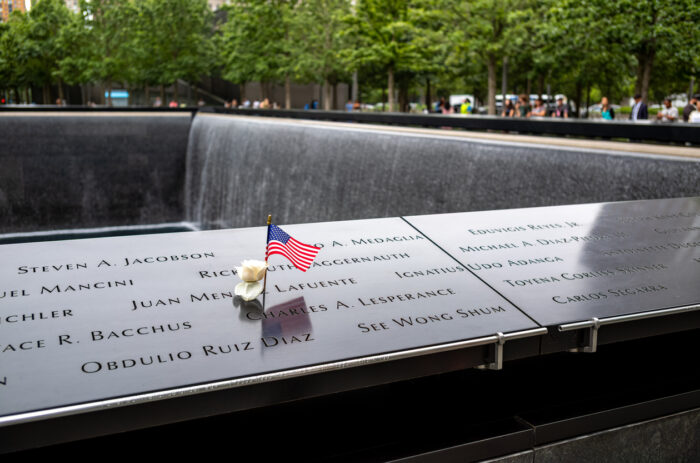
Clal Reflects on Rosh Hashanah, the High Holidays, and the 25th Anniversary of September 11, 2001.
Introduction: Mobilizing Memory — By Rabbi Brad Hirschfield
Both Rosh Hashanah and the anniversary of 9/11 mean many things to many people, and coinciding as they do this year invites us to think about them together. Whatever else these days mean to us, they are both days that invite us to remember. 9/11 conversations, especially on the day itself, invariably include remembering where you were on that fateful day, and Rosh Hashanah is called “Memory Day” in traditional Jewish liturgy.
Memory is central to these days, but what do we remember, how do we remember, and to what end do we remember? Those are always the real questions when it comes to remembering, especially when we appreciate that memory is as much about the present and the future as it is about the past. That insight is as old as the Bible itself, going back to Noah, Sarah, and Rachel, to name just a few stories that highlight that understanding.
In each of these stories, God remembering Noah (Genesis 8), Sarah (Genesis 21), and Rachel (beginning at Genesis 30:22) is neither about the past nor about God having forgotten them; instead, God’s remembering each of them serves as a hinge in their story so that the present is transformed and the human characters can begin to move more fully into the futures they desire. These are stories of remembering forward, and that is the kind of remembering we need, especially at the intersection of the 25th anniversary of 9/11 and the beginning of a new year, which according to Jewish tradition marks the anniversary of the creation of the world and humanity as a whole.
In that spirit, members of our faculty and staff are taking the opportunity to do more than look back, as important as doing so is. What follows are personal reflections about remembering forward and considering how each of us can mobilize memory to create more of what we want, be more of who we want to be, and not only to pray for a happy, healthy, peaceful, and prosperous new year, but to play an active role in making our prayers come true.
There are so many things I could write about my experience of September 11, whether about trying desperately through jammed phone lines to reach my sister who watched the towers fall out her engineering class window on the Lower East Side, or sitting in front of a dorm room television on Harvard’s campus and realizing this meant the U.S. would be entering a war and all our lives would change. In the autumn of 2001, I was in the middle of a religious awakening, and the terror attacks became part of that story. I’m especially thinking of two snapshots of moments from the week that followed.
The first is from Rosh Hashanah, seven days after the towers fell. The thing you need to remember for this story is that both flights that hit the World Trade Center that day took off from Boston’s Logan Airport. A week later, I sat in my childhood Reform synagogue in Newton, Massachusetts, and one of our congregants who was on one of those flights was dead, and the rest of the congregation was trying to make sense of what had happened. There was a stunned heaviness in the room. When we came to the Unetaneh Tokef prayer, whose central premise is that during the time between Rosh Hashanah and Yom Kippur our fates are sealed as to who shall live and die and by what means, the rabbi stopped. With a wavering voice, he shared that this year he simply couldn’t say this prayer. What had happened shouldn’t have happened, and to say that it was decreed would be a lie. It was the first time I remember that a) a prayer I hadn’t really understood before came alive with real meaning and implications for me and b) I wholeheartedly disagreed with a ritual decision by someone I respected. Although I understood where the rabbi was coming from, I discovered that I am a person who would rather start by wrestling with and trying to reinterpret what is there, rather than removing it, and that I might be shifting away from the denomination of my upbringing.
The second snapshot I want to share takes place in a small park next to the Charles River at night. In the days following September 11, I wanted to find a way to help. I had come off a spring semester of organizing for worker rights and a summer Jewish learning fellowship through my Hillel. I decided that even if from Cambridge I couldn’t directly impact those at Ground Zero, I could help fellow students and others to find hope. I put up posters on campus inviting people to a “havdalah of hope and healing.” Four days after the attacks, I trudged to the park with a flashlight, siddur, havdalah set, and poetry in hand, hoping others would show up. In the end, not only were there half a dozen students from Hillel, where I had only recently gotten involved, but also several from my worker rights group I didn’t know were Jewish. Perhaps most important to me at that moment, my Hillel director Dr. Bernie Steinberg z”l and one of my Hillel rabbis, Rabbi Sharon Cohen-Anisfeld, came to be led in ritual by me that night—a student who was just getting her sea legs in this whole traditional ritual leadership thing. Sharon even brought her young kids. Both would be lifelong mentors and friends to me. My experience that night taught me that I held the power to create ritual and comfort, and I didn’t have to wait for anyone else’s permission or suggestion—that in fact, I might be the very one in that moment to do it.
My life changed in many ways 25 years ago, and to the extent that I remember this 25th anniversary of 9/11, and I certainly will, I also want to remember another life-changing event that occurred just a few months prior to that one. The event was the birth of our third child which, if I am honest, changed my life even more than did the events of 9/11. And for that reason alone, I remember the two alongside one another. Doing so reminds me that global events are big, but in many ways, when it comes to personal impact, more intimate events are often bigger. Something I fear we often lose sight of, especially as we experience a daily deluge of “big stories” that purport to change the world.
9/11 changed the world, for sure, but did it change my world as much as I allowed myself to believe and feel? Probably not, and since I lost nobody super close to me, it should not have. I use the “should” cautiously, but I do so because we often confuse the claimed impact of events and the actual impact of events—conflating scale with meaning.
There is no question that 9/11 changed the world more than did the birth of my daughter. But appreciating the difference between “the world” and “my world”—for any of us—helps keep the kind of perspective that we often lack. The kind of perspective that keeps us focused on the people and things about which we can actually do something. The kind of perspective that keeps us from spinning out in angry assessments and shrill predictions that dominate so much of contemporary conversation. And in that regard, the coincidence between 9/11 and Rosh Hashanah this year is quite useful.
As much as Rosh Hashanah celebrates the birth of the world and humanity as whole, it reminds us even more to look closer to home, to ourselves, and to the things we can repair in ourselves and in the relationships we have. In fact, of the many holidays that occur across the Jewish year, there is none as deeply personal as Rosh Hashanah, which has no obvious connection to any national or agricultural event in the life of the Jewish people.
Even Yom Kippur—the Day of Atonement—echoes themes of national liberation and the resetting of social norms toward greater equality, through its connection to the Biblical Jubilee year. But not so with Rosh Hashanah, which invites us and challenges us to slow down and remember that the “small stuff”—the deeply personal stuff—may be the biggest stuff, and that it is certainly the place from which we can begin to make the differences we want to make in our lives. I hope to use both my memory of 9/11 and my observance of Rosh Hashanah to do just that, and hope that each of us, in our unique ways, does the same.
One year after 9/11, I was starting rabbinical school, and right before its anniversary, I had to drive from my home in New York to HUC-JIR’s campus in Cincinnati. Just beforehand, one my favorite columnists, Dave Barry, had written one of the most beautiful reflections about how Shanksville had become “hallowed ground,” and linked it to the Battle of Gettysburg. As he notes, “Nobody planned for the battle to happen here. Neither army set out for Gettysburg. But this is where it happened…[and] nobody on Flight 93 was heading for Somerset County that day.” Unlike chosen sites like Washington, DC or Jerusalem, both Gettysburg and Shanksville became holy places due to random circumstances.
Since it was not far off my drive from New York to Ohio, I budgeted a couple of extra hours, and stopped where United 93 had crashed. There was a simple memorial, and I felt the impact of the heroism and sadness of the unexpected location. But even now, 25 years later, there has still not been a formal dedication of this sacred ground. In many ways, that feels most appropriate. In my mind, so much of what makes our country resilient and special comes from the small day-to-day acts of heroism, togetherness, and support we see. While our national politics have become even more toxic since then, we have learned to see the power of ordinary people.
On Rosh Hashanah and Yom Kippur, we read Unetaneh Tokef to remind us that randomness influences our lives in ways we can’t always expect. We do not know in advance who will live and who will die. And yet our small actions matter—our teshuvah, our tefilah and our tzedakah can have cosmic significance.
And there was another connection I felt staring out at the empty field. Going to Shanksville just one year after 9/11, and recognizing that it would have been an otherwise unremarkable location, I felt much of the same power that’s described in the machzor, with only the High Priest says God’s name inside the Holy of Holies on Yom Kippur. Sometimes, we know in advance that a time and place will be powerful and meaningful. And sometimes, we don’t. Sometimes, we understand the how and the why only through the lens of time. To me, that field in Pennsylvania was holy ground, even as it was a place no one on that flight intended to be. Now that twenty-five years have passed, it’s striking that what we remember is not so much the sadness and shock of the day, but the heroism that so many exhibited in the years and decades that followed.
“The second tower has fallen. Class is dismissed,” my History of Industrial Design professor said, her face blank, after an aide arrived five minutes late and whispered something in her ear. I grabbed my notebook and ran outside into the acrid air of a burning city, a smell I have never been able to describe or forget. It was the first day of my sophomore year, and from the Pratt Institute main campus in Brooklyn, we had a direct view to Manhattan’s financial district.
Where the two towers had once anchored the skyline was now a cloud of smoke and ash. What struck me immediately was how beautiful it all looked—millions of glass shards sparkling in the bright morning sun, suspended in the thick, ashen air. As an art and design student, I had been trained to draw or paint what I see, to focus only on the composition that fit inside my finger-made viewfinder. In that moment of devastation, I found myself frozen and mesmerized by the eerie calm beauty the towers left in their wake from a distance. In that double absence, the glass instantly reminded me of the Jewish wedding tradition of smashing the glass, a reminder that even in moments of great joy, to hold both the destruction of the two Temples and the memory of other times of grief alongside the celebration.
Of course, once I came back to myself, I felt unsettled that that’s where my mind had gone in those initial moments. Some fellow students and I spent the rest of the day doing what we could. We ran down to the Brooklyn Bridge to hand out water and clementines to those fleeing downtown, some barefoot, high heels dangling from their bags. We gave blood at a nearby clinic. We held each other and waited for news of professors and classmates who still hadn’t been accounted for. In the coming weeks and months we watched neighbors and strangers show up and care for each other in ways we couldn’t have imagined.
As we welcome this new year and mark the 25th anniversary of September 11, celebrating Rosh Hashanah amidst so much devastation in the world, I find myself returning to that morning on the quad. While the broken glass at a wedding reminds us to hold our grief even in moments of joy, I hope my memory of September 11 reminds us to find the beauty in our small viewfinders, even when it feels like we’re surrounded by so much loss.
I was headed to class in college when I heard the news that a plane had flown into a building in NYC. That news didn’t make any sense to me. I quickly went over to a friend’s apartment where we watched events unfold live on television. As we watched the towers collapse, I felt a deep sense of shock, horror, and dread. We looked at each other and knew the world would never be the same.
Even now when I think of that moment twenty-five years later, my shoulders become tense and my stomach begins to churn. I feel the emotional echo of that moment in my body. So much history has unfolded in the past twenty-five years, and yet my memories of Sept 11, 2001 still feel real. Modern psychology teaches us that trauma lives in our bodies, but the body-based nature of memory often surprises me.
One of the most potent symbols and practices of Rosh Hashanah is the blowing of the shofar. However, because of the rabbinic prohibition on blowing the shofar on Shabbat, this year most traditional communities will wait until the second day to hear the shofar. Rather than experiencing Rosh Hashanah as a day of shofar blowing (Yom HaTru’ah, Numbers 29:1), we will experience it as a day of remembering shofar blowing (Zicharon Tru’ah, Leviticus 23:24).
As anyone who has heard the shofar knows, hearing its blasts constitutes a profound embodied spiritual experience. The shofar represents birth, alarm, victory, and a demanding invitation that we wake up to the reality of our lives. When the shofar is not sounded on the first day of Rosh Hashanah, we feel its absence and we long for its return.
The spiritual invitation of a shofar-less Rosh Hashanah is to lean into memory. Just as we remember traumatic events in our bodies, so too can we remember transcendent moments, such as hearing the shofar. Because we do not have the sound of the shofar to help us direct our attention inward, we must rely on our memories. We must choose to remember so that the shofar—even in its absence—becomes a force for good in our lives.
A shofar-less Rosh Hashanah is also a reminder that we have choices about what we remember and how we remember it. Memories of trauma may live in our bodies, but so do memories of joy, connection, hope, and resilience. When remembering Sept 11th, 2001, I may always feel an echo of the emotional experience I felt on that day. However, rather than focusing exclusively on my grief, I can expand my awareness to include the gratitude I felt at not having to experience that moment alone. My heart warms at the memory.
As I move forward into a new Jewish year, I want to remember that I have family, friends, and communities that will be with me through hard times. There are many broken and unfinished parts of this world, but I am grateful to have partners in the work of building a better future together.
As the youngest of four children, my oldest brother Ari, is 13 years my senior. So while I was glued to the portable television my teacher, Mrs. Shapiro, wheeled into my freshmen year high school civics class on 9/11, my mind was split. This was really happening and where did my brother Ari work in New York City? I was caught between these two poles of this vast tragedy, and the deeply personal potential impact that was unfolding before our very eyes.
In the days of early cell phone technology, you might remember that it was nearly impossible to get a hold of anyone in New York City because the cell phone network was so jammed. It wasn’t until later into the evening that my family could breathe a sigh of relief as we learned that Ari, his now wife Emily, my uncle Gary, and cousins Darren and Chad had all made the trek, by foot, up to their home. The stories that they told of that journey were of unimaginable grief pierced by powerful moments of human connection and togetherness: strangers walking hand in hand, sustenance being doled out by business to humans in need. \
The duality was as striking then as it is now and I am reminded of it as we come upon Rosh Hashanah where a similar duality exists. The current Slonimer Rebbe, Rabbi Shmuel Berezovsky, notes that it’s a day of contradictions. Although Rosh Hashanah is a day of rejoicing, Yom Kippur is the Day of Judgment. He asks, “How, one might ask, can one rejoice on a day so awesome and fearsome, when the Books of Life and Books of Death lie open?” (Darkhe Noam, Discourse 4, Rosh Hashanah) In a long ranging discourse, the current Slonimer Rebbe answers this question through an analysis of the piyyut (liturgical poem) L’El Orekh Din, focusing on the line:
Who probes hearts… Who reveals depths in judgment

He posits that the very same act of scrutiny that makes the day terrifying is what makes it a festival, because it uncovers something underneath the fear that’s worth celebrating.
As this year’s Rosh Hashanah falls right on September 11th, it’s hard not to draw the parallels, as I reflect on my own experience as a 14-year-old. The books of life and death seemed viscerally open on that day as I wondered what had happened to my brother. And then, at the end of the day, rejoicing came after much scrutiny because life persisted. And we were the lucky ones; thousands of others found themselves mired in grief and agony as they lost their loved ones.
I think that duality persists to remind us of something. Moments like 9/11 are unique in their context, yet life is filled with events that place us starkly in between tragedy and triumph. Our work as Jews is to uncover the kernels of goodness they contain, like the way the citizens of our country showed up for one another in those harrowing days. May the memories of those lost and the spirit of Rosh Hashanah—gleaning goodness concealed beneath fear—inspire us to a year full of maasim tovim, of good deeds, amid our hectic lives.
Twenty-five years ago, on 9/11, I was spurred into educator action. While the fires of terror burned, we had to decide what to do with our 700 K-8th grade students at school. It was my first year as a Jewish day school Rabbi. My job was to create the first part of a dismissal assembly. We had to share the news and bring order to a world of chaos.
I put aside personal fears and worries about family and friends who worked in NYC and near the Pentagon. I sidestepped anger and the revived trauma I lived through during Jerusalem bus bombings a few years earlier. Stay cool, I told myself, because in a moment there would be students shuffling into the sanctuary who knew nothing but a world of goodness and order.
The assembly opened. 9/11 was a Tuesday. A D’var Torah, words of Torah, would help us find our way forward. “Tuesdays are supposed to be a doubly good day, not only because it’s no longer Monday. That is because in the Torah, in the creation story, it says ‘ki tov’—it was good” twice for Tuesday. There was a double dose of evil, though, unleashed on the world today, and chaos showed its face. It is not the good we or God hoped for.” And then we broke the news. Middle schoolers can be so mature. Some cried, and some were confused. I remember the sadness that came over me, as I shared about the murderous terror.
In the minutes before the assembly we had pulled school lists and family emergency cards. We called families one by one. The safest place and most reassuring place, we believed, would be in the loving arms of parents, siblings, family and friends. An orderly dismissal was reassuring in the face of the chaos unleashed on the world.
A group of us was left in the office. We took a breath. We looked at each other. One of the rabbis asked, “Who has not yet said the blessing over bad news?”
Yes, the blessing. According to the Talmud, we bless over the bad as well as the good. Why? Because there is a theological safety net to asserting that evildoers will receive their just desserts. Blessed are you, God, who is the Ultimate Judge.
I led the chanting of Psalm 94. This liturgy built on the theme. It serves as the Psalm for Wednesday, but it worked for that Tuesday. I remember feeling steadied when I read: “God will be our fortress…” We needed protection. We needed an advocate for justice.
Twenty-five years later, I remember hoping and praying that we would bring the perpetrators to justice. I remember feeling thankful that I worked with such caring educators who believed so deeply in a world that could be filled with the goodness God saw during creation.