
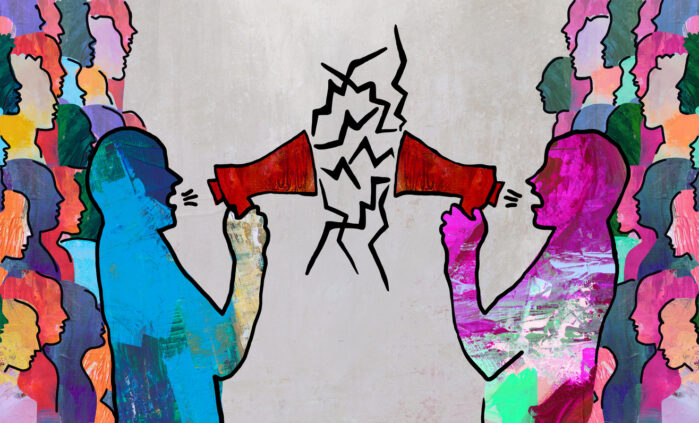
We have a word for people who can’t handle criticism.
Snowflakes.
The word is usually thrown at a younger generation—people who, supposedly, are too fragile to hear that they’re wrong, too sensitive to tolerate disagreement, too easily offended by criticism.
And maybe there is some truth in that critique.
But here’s the funny thing: Apparently, we’ve been snowflakes for a very long time.
Masechet Arakhin creates the scaffolding of a question that has pierced our Jewish community. There is a teaching about Rabbi Tarfon about tochecha, rebuke:
I would be surprised if there is anyone in this generation who can receive rebuke. Why? Because if the one rebuking says to him: Remove the splinter from between your eyes, i.e., rid yourself of a minor infraction, the other says to him: Remove the beam from between your eyes, i.e., you have committed far more severe sins.

Rabbi Tarfon boldly claims that no one these days can really handle criticism, using the metaphor of barriers to seeing. If someone suggests you have “a splinter from between your eyes” and you respond that they should instead remove the “ beam from between your eyes,” it would seem that you are not very good at receiving any rebuke.
This dynamic of one-upping rebuke concerns the rabbis of the Talmud. The Torah is actually filled with examples of people deflecting blame, but they aren’t lobbing back their own accusations. When confronted by God in this week’s Torah Portion, Bereshit,, Adam blamed his sin of eating the forbidden fruit on his wife: “The woman you gave to be with me, she gave me of the tree and I ate” (Genesis 3:2). When confronted by God about Abel’s murder, Cain deflected right away, saying, “I don’t know; am I my brother’s keeper?” (Genesis 4:9). When confronted by Moshe, Aharon blamed the sin of the Golden Calf on the Israelites: “You know these people are evil” (Exodus 32:22).
It’s the tendency to respond to criticism with a conversational kill switch that causes the Talmud to doubt our ability to take criticism to heart.
Do you find this in your own life? I left the dishes in the sink overnight? Well you didn’t fill up the gas in the car. I interrupted you? Well you interrupt me all the time! When people confront and corner us, we reach for a seemingly random criticism of them that we were sitting on this whole time.
There’s a term for this: “What-aboutism.” It’s a communication tactic that avoids answering a critical question or accusation by instead making a counteraccusation or bringing up a different issue. It’s become a trend in argument styles, and—if I may be so bold—a danger to our spirituality. In fact, it is really the antithesis of Yiddishkeit, Jewish values.
Now, maybe the critic really does have a “beam in their eye.” However, in the example Rabbi Tarfon brings, the problem is that the other person’s beam has become a reason not to remove our splinter. Rabbi Tarfon finds this spiritually devastating, because tochecha (loving rebuke) only works if we can temporarily suspend our need to establish that we are not the worst people in the room.
Rabbi Kalonymous Kalman Schapira (otherwise known as the Piaseczna Rebbe) addresses this directly in his book Chovat HaTalmidim:
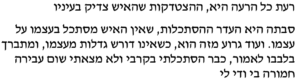
The worst of all evils is that of self-justification, the one where one sees himself as righteous in his eyes. Foolishness is the lack of self-examination; this person does not look and examine himself inwardly. Even worse, he does not demand anything great of himself. He reassures himself by telling himself, “I’ve already checked with myself, and there’s no sinful activity there to change, and that’s enough for me.”
No notes.
Interestingly, the Hebrew word hitztadekut (self-justification) is the hitpa’el grammatical form, meaning it is a personal reflexive verb of the word tzedek (justice). A closer translation would be “to justice oneself.” While we would hope it would mean accepting our own mistakes and praying for God to rule on them with compassion, today it’s more likely that we self-justify our wrongdoings to throw some kind of moral distraction in God’s eye.
On Rosh Hashanah, we are accustomed to thinking that the central question should be, “What did I do wrong?” The Piaseczna Rebbe suggests that an even deeper question for this year is, “What story have I told myself about what I did wrong?” When we can explain everything away, we become incapable of teshuvah.
Sometimes admitting wrongdoing can bring about a sense of loneliness. Accounting for our part in creating harm can feel like a spotlight is shining on our deepest insecurities.
In this week’s Torah portion, Adam deflects from his own sin, instead blaming his wife. Reb Mimi Feigelson, Mashpia Ruchanit (Spiritual Mentor) at Machon Schechter, shared a chassidic teaching that reimagines this vulnerability:
After Chava ate from the Tree of Knowledge, she realized that she was going to die. She became afraid—not simply of death itself, but of having to face death alone.
She told Adam that she was afraid to die alone.
Adam responded, in essence: “You don’t have to die alone. I will die with you.”
It was taught that this is why Adam also ate from the Tree of Knowledge: He chose to share Chava’s fate rather than allow her to face it by herself.
This Chassidic insight invites a different narrative of accountability. One of the greatest acts of love we can do is to accompany someone we love into their deepest fear, so that they needn’t be alone.
When someone we love rebukes us, we shouldn’t outsmart, blindside, or deliver our reactionary what-aboutisms. In an act of spiritual counter-culture, we can be the kind of people who accept tochecha with a two-word complete sentence: I’m sorry.
I’m sorry. Not, “I’m sorry, but…” Not, “Yes, but you made me do it!” Not, “I may have a splinter between my eyes, but you have a beam between yours! My mistake is bad, but look at the size of yours!”
No. Simply, “I’m sorry.” Full stop.
When we respond to critique with these two words, we are disarming everyone—ourselves, our rebukers, and everyone looking to see how we will engage with one another. We are modeling the vulnerable loneliness that comes with that.
I pray that our sincerity is met with humility. That our willingness to let criticism wash over and refine us be mutual and kind. That this exercise of replacing our justifications with justice be effective. But if and when it is not, may we keep trying and trying again, just like how the Ribbono Shel Olam (Master of the World) lends us mercy over and over again.