
Sometimes, when I’m by myself, out on a hike in nature, I think about weird stuff. Like this summer, when I was walking a trail in Glacier National Park in Montana, I had the Yiddish phrase, “Sha, shtil,” repeatedly running through my head. It literally means be quiet, but it can also mean don’t make a fuss, don’t mix in, don’t rock the boat—the consequences of getting involved are too risky. And then I thought of the gallows humor joke. You may know it: There was once a Jew standing with his friend before a firing squad, awaiting their impending execution. The commandant comes over and asks if he has a final request. The Jewish person timidly answers, “Yes, may I please have a blindfold?” Overhearing this with alarm, his friend leans over to him and whispers, “Sha, shtil—don’t make trouble.”
Later on the walk, I saw a fairly significant hole in a tree stump that was covered over by a spiderweb. My mind immediately went to the Midrashic legend that describes the youthful David, fleeing from King Saul and his army in the wilderness of Ein Gedi. Previously, David wondered about the importance of a mere spider. David found a deep cave in which to hide and then suddenly a spider appeared and wove a thick web across the cave’s opening. When the army arrived and saw the web, they moved on, thinking that no one could have gone into the cave without breaking the web. The Hebrew Bible’s version has no spiderweb. Rather, Saul enters the cave with his army. David, hiding unseen within, sees the king and chooses not to harm him. Instead, he cuts off a corner of Saul’s robe. Later, David confronts Saul and presents the fabric to him, reminding him that he, David, is innocent, and that when he had a chance to kill the king, he didn’t.
The rest of the hike that morning was beautiful although I kept wondering: Why would Saul go after David? David was a musician, helping King Saul. Saul knew that the Eternal was with David and he knew that he was on the way out—yesterday’s news. King Saul tried vainly to destroy the person who represented his own loss of power. In the Midrash, David survives because he is not seen at all. In the Book of Samuel, David survives because he chooses not to act. And for us? We ask ourselves whether there are times when Jewish survival requires us not to hide, but to be seen.
Soon after 10/7/2023, I discovered that some of the interfaith relationships across the city I thought were strong were not as strong as I imagined. We were met by silence, by dismissal, and by not taking us seriously when we said we were hurting and looking for support. I was ignobly dropped from my teaching in the Christian seminaries in town. Shortly after 10/7, one of the Christian communities with whom I had worked for years invited me to speak. However, when I explained that I would talk about the murder of Jews because they were Jews, I was told that this wasn’t the conversation that they wanted. On the phone, the organizer presented the talking points that they wanted me to cover. I refused and I was disinvited on the spot. And I haven’t heard from anyone in that community since.
But not all of these relationships broke. One that has flowered has been studying scripture with my friend, Pastor Rick Randall. We meet a couple of times a month. This experience has been joyful, interesting, and healing. Studying Leviticus with a Christian friend and discovering the Book of Revelation as a rabbi makes me more curious, more knowledgeable, and more alive. I still speak a couple of times a year at Trinity Episcopal and St. Andrew’s Episcopal Schools. We cannot retreat from public life simply because public life has sometimes hurt us. Jewish survival has sometimes required hiding. But Jewish flourishing requires cultivating relationships, creativity, energy, participation, and visibility.
Sometimes the most Jewish thing we can do in public is to be Jewish and not talk about being Jewish at all. It is to create something beautiful that could not otherwise exist. So perhaps the best work I do in our city is producing the monthly jazz series at the Cactus Café, as rabbi and jazz historian Neil Blumofe, not just as Neil Blumofe: I model what carefully considered positive interaction can accomplish. Perhaps the sweetest part of these evenings, beyond the music and the feelings engendered in the space, is the lines of students sent by their teachers for their listening requirements, who are encouraged to learn more, not just about the music, but about the world around them, and also about themselves.
As Jews, we have spent generations learning how to survive by becoming less visible. Rosh Hashanah asks us to become more fully visible, like a waxing moon. Today, we stand at the beginning of a new moon. It’s just beginning to appear, and over these next few days of aseret yemei teshuvah, these 10 Days of Returning, it will continue to grow. Perhaps we can do the same with our Jewish visibility, becoming a little more visible than we were yesterday. We are not to be provocateurs, but rather we are to be people who take responsibility and have courage to be Jewish in public.
Over the years, I have presented the stories of Rosh Hashanah from various perspectives. This year, I would like us to think about the protagonist, Abraham, who is learning how to be Jewish on his own terms and in his own skin. He is not performing a role or acting as a foil for someone else. He has agency, and over the scope of his life, he learns not to just drop his kids off at Religious School, or outsource his Jewishness to the next generation.
Abraham doesn’t begin as Abraham. He becomes Abraham through a series of encounters in which he has to decide who he is. Every day he is learning not to hide and to step out of the shadows. Hineni. Here I am. We make a mistake if we cast Abraham’s labors as superpowers. Abraham, like each of us, is hiding in plain sight. Who are we becoming through the choices we make today?
The spiderweb over the cave makes David invisible. Over history, we have gotten very good at disappearing. David survives by hiding. Abraham is becoming Abraham by answering the call. We can learn when each response is required.
We have been told to hide for generations. Sha shtil, don’t make trouble. In 1863, Yehuda Leib Gordon, a poet of the Jewish Enlightenment, the Haskalah, wrote about his age: “He’yeh adam b’tzeit’cha v’yehudi b’oh’ho’lecha—be a person in the streets and a Jew at home.” Gordon wasn’t telling Jews to be ashamed to be Jewish. He was proposing a bargain, for his time: become fully participating citizens in the world and preserve your Jewishness behind closed doors.
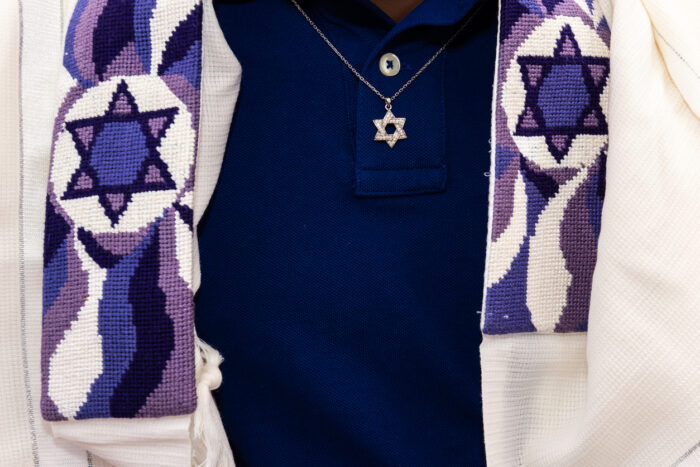
That bargain is not sufficient for us anymore. Gordon advocated for Jews to integrate into secular society—to learn the local languages, to adopt modern dress, to cheer for the Longhorns or the Aggies, and to participate in society as equal citizens. And at home, to quietly and privately maintain Jewish heritage and traditions. Put the mezuzah on the inside of the door. If you must wear your Jewish star, your Magen David, wear it under your shirt. We know how to be Peter Parker, the alter ego of Spider-Man—ordinary, unobtrusive, indistinguishable. Sha, shtil. And there are times when hiding saves a life. But a strategy for survival can become habituated, a way of living. And there comes a moment when surviving is no longer enough. We also must live. As Jews we need to live out loud, with our starry drip on full display.
We are not supposed to be superheroes. We are supposed to be visible human beings. We are not to rely on the heroics of Spider-Man, perpetually in costume. Spinning a web of David, a web of any size, is not our superpower. Rather, we can wear a Star of David, a star, any size. You don’t have to become extraordinary to live courageously. We should no longer just pass invisibly on the street. Step up Abraham, step up Peter Benjamin Parker. Be willing to be seen. We are done trembling in the basement of Pharaoh’s house.
Don’t make trouble? Blech. We know how important the Pride Flag is, for example, powerfully encouraging people to stop hiding. As Jews, as Am Yisrael, we too need a symbol of courage, a visible reminder that we won’t pass, that we won’t hide, and most importantly, that we won’t be erased. The other day, I was sitting around a restaurant table with some young men, most of whom had their Magen David necklaces proudly displayed. Sitting with them was an exhilarating feeling. We didn’t talk about anything crucially important, mostly football, sports betting, and what’s going on in their lives in these moments. And yet this was truly dancing with the stars. I felt less alone.
We too can courageously wear our stars, wherever we go. These stars can’t change other people’s fear or hatred. But they can change us and root us in our own lives, unwilling to disappear. Dara Horn has written a new book about antisemitism whose title contains an extraordinary phrase: A Love Story for the Living. That’s what this star is. Not a badge of Jewish fear, but rather a declaration of Jewish life.
This year, let us devote ourselves to not being quiet. Let us from all of our places reclaim our Jewish peoplehood. Horn defines Jewish peoplehood, Am Yisrael, as a joinable tribal group with a shared history, homeland, and culture. This is us. Fall in love with us. For starters, expand your Shabbat table, even by one; make it intergenerational; and laugh and enjoy the gift of being together. Learn more; resist deliberate ignorance. Resist your own erasure. Patiently answer questions that are posed to you, even if you are not sure of the answer. Your thoughtfulness, your attempt, will prevail. Revel in ordinary moments: Seek out opportunities to be Jewish in the streets. Know that our Jewishness, our peoplehood, is generative. This is how we beat back the paranoid energy of King Saul. Like David, we sound the essential music of our soul, and that music, no matter where we’re from, is Jewish music.
That music cancels our spiritual dread. This is our job now. This star is more than a religious symbol. It is not a political statement. Rather, it is the value proposition of being Jewish. Wearing it every day teaches a master class in courage itself. We know that the star cannot protect us or magically make the world safer. It won’t make a hater disappear. However, lo tishkach! Don’t forget! (Deut: 25:19) Every day, wherever we are, the star can remind us of what we refuse to forget. We are here.
Those who traffic in hate do not distinguish Jews, ally or enemy. The winds are always shifting. Let us not dance for others. We are not marionettes. Let us set the ground rules of how we shall live in this world. Cautionary tale: Consider Don Isaac Abarbanel, a 15th-century Jew who served kings and queens. He accumulated wealth and lost it, over and over. He fled from tyrants. He rebuilt. He negotiated with rulers who could have changed his fate, and the fate of the Jews in Spain. He offered everything he had so the Inquisition wouldn’t happen. He gave everything to the king and queen and they delayed the Inquisition by about three days. And finally he died in exile, his grave unknown. Kings change, countries change, fortunes change. Our peoplehood outlasts the king. Am Yisrael Chai.
Let us be principled like Simona Mohamsson, the Minister of Education and Integration and the Liberal Party leader in Sweden. In a recent public debate, she chose to wear a Magen David around her neck. Here is a Swedish political leader with Palestinian and Lebanese family roots, choosing to wear a Star of David publicly. She said, “I wear the Star of David for the children who do not dare so in today’s Sweden.” Here is a young leader, 31 years old, choosing to wear a Jewish symbol because Jews around her are afraid to do so. What would it mean for us, as Jews, to be willing to wear our own symbol? The star around our neck, David’s star, shows that we will not hide, and we will not stifle our mission to make this world better and to serve our God.
Come out, come out wherever you are. The spiderweb begins as something that conceals David. The Star of David now becomes something that reveals us. We don’t have to agree with each other to agree to wear it. Let us live fully into who we are. Don’t keep Jewish courage to yourself. Clear the cobwebs. Shine out your beauty, your intellect, your spirituality, your joy, and your unflagging involvement in this difficult world. Strengthen a feeling of both natural and Divine presence. Especially in uncertainty, call upon an invincible gladness so that none of us ever have to feel alone.
Now members of our community are going to come through the aisles with a gift for each of you. Take it and use it, and if you have one already, give it to someone who might not. Some of us will wear this star. Some of us won’t. Some of us will wear it tomorrow and take it off soon thereafter. Some of us will give it away. Courage doesn’t look the same for every person. But none of us should have to disappear in order to belong. Don’t think of this star as a command, think of it as a question. Where will you put yours? Will you wear it? Whatever you do with it, let it ask you something: Where are you hiding? What parts of ourselves have we decided that it is safer not to show? Where can I show up, not as a superhero but simply as myself? What does Jewish visibility mean to you? For generations, Jews learned to survive by hiding in plain sight. This year, let us learn something else. Let us learn how to be fully visible without becoming combative, fully Jewish without becoming defensive, and fully present without becoming afraid. We belong to each other and all of us have important work to do. Hazak v’ya’ameitz libecha—let us be of good courage.
You can watch Rabbi Blumofe’s sermon here, starting at 2:28:26.