
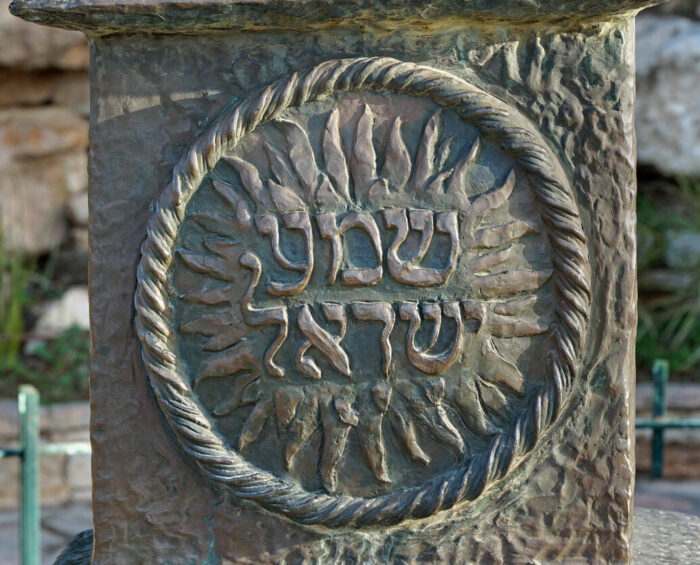
GOD said to Abram, “Go forth from your native land and from your father’s house to the land that I will show you.
I will make of you a great nation,
And I will bless you;
I will make your name great,
And you shall be a blessing.

In that moment, Abraham heard God’s call and got centered on his life’s mission. Sarah heard, and she agreed to the journey.
Notice what the Torah does not say at the beginning of Parashat Lech Lecha, the Torah portion where the first family of the Jewish People and first ethical monotheists are introduced to the world: It does not say be holy; it says “be a blessing.” It’s not that we have to be holy like God, even though being created in God’s image makes each of us holy and deserving of proper treatment. Rather, we should live in the key of Abraham and Sarah: pursue blessings and be a blessing, and by doing so all those who will come into contact with us will be blessed.
The triplet of commands to build a nation, make a name for himself and to be a blessing given in Genesis 12:2 above begins with the assignment to create a nation. Quite the tall order! But Abraham and Sarah believed that they could create a clan and settle in the land God promised to show them. Making their names great, in Torah terms, meant earning a reputation as a doer of good in the face of struggle or when someone needs help. God helping Israel out of Egypt made the Lord’s name great according to the prophet Isaiah. The third part of the commandments God gives above are that Abraham and Sarah are to model and pursue a life full of being blessings, bestowing blessings, and helping others become blessed.
So what does it mean to be a blessing to each other? Ovadiah Sforno, the famous Italian Torah commentator, explains that to be a blessing means our deeds and actions should cause rejoicing both among humanity and in Heaven. When nation-states cooperate to bring potable water to each others’ populations or neighbors share half a stick of butter or a few eggs, we bless each other and make Heaven smile.
At the beginning of this week’s Torah portion, I sense that God really rejoiced when Abraham heard his essential message for the Jewish People and the world. Hearing and agreeing to live by God’s commandments requires a mindful embrace of them. That remarkable moment when Abraham and Sarah heard the Lord helped them clarify what their responsibilities and goals would be for their lives. They were told to leave their comfort zone, move themselves on a journey to the land of Canaan, today’s Modern Israel, and bring a family together who would dedicate themselves to recognizing our One True Creator God, welcoming guests, and pursuing a life of justice and charitable acts, tzedakah. I read into Abraham’s affirmative response a hope that the Torah is expressing for all of us: If we turn to hear God, we will more deeply understand our unique missions in the world.
I believe that we can all have Lech Lecha moments. And that means we can help build the nations in which we live, develop our personal missions of pursuing righteous work, and take on the responsibility of being and becoming blessings to those in our communities and to those whom we love. These are as an organizing responsibilities for my life. Back in my twenties, I served on a neighborhood board and helped raise funds for a theater and drama therapy program for prisoners. During my first post in Michigan, I endeavored to find sacred texts that could create bridges of understanding between and among Jewish, Christian, and Muslim communities who were working together on the issue of cleaning up water supplies. Today as a rabbi in New York City, our congregation is committed to building the nation of Israel and the Jewish People, volunteering as tutors when people request help to earn their degrees, and organizing to help with choice pantries to address food insecurity in our community.
People have shared with me their concern that their work has taken over their life, and they can’t focus on being blessings in the corporate space. I like to share the story of a dear friend who was a CEO of a multinational corporation. He decided to include in new employee onboarding sharing the company’s goals of helping develop every employee to their capacities and to enable them to contribute back to their surrounding society. He designated a certain percentage of profits to go into a corporate foundation that educated students around the world and supported local causes. Finally, he used his strategic business skills to help a non-profit for veterans scale up. That group now dispatches teams of ex-soldiers and armed forces experts to disaster areas not only to help clean up but to train and work alongside local populations in rebuilding broken communities. When we focus seriously on the task of becoming a blessing, we live as Abraham promised.
For I have singled him out, that he may instruct his children and his posterity to keep the way of GOD by doing what is just and right, in order that GOD may bring about for Abraham what has been promised him.

We can learn from how Abraham readied himself to figure out the focus of his life’s work. The first action verb used after he heard God is “And he put his feet to the ground…” and went to Israel. For a time, in our culture especially during the 19th and early 20th centuries, great men and women visited the Holy Land for inspiration. People like the writers Mark Twain and Herman Melville, the “father of archaeology” Edward Robinson, and before he became president Theodore Roosevelt. We can read about the power of their imaginations over the course of their lifetimes and when the land of Israel herself became a lighthouse for their minds.
For millennia after God called Abraham to a higher purpose and invited him to go to the Land of Israel, generations of Jewish souls have set out like Abraham and Sarah to walk the sacred land and let it help refine their outlooks and amp up their soul energies, whether they were staying there or taking their places in diaspora communities. That is a blessing open to all of us at this time in our world.
The Sefat Emet, Rabbi Yehudah Leib Alter of Ger, taught that the command of Lech Lecha, go forth, was not a private whisper spoken exclusively to Abraham. God’s voice, he says, echoes perpetually through the cosmos and calls out to all human beings at all times. It’s not always easy to know how to be a blessing to the ones we love and those around us. When God said to Abraham “be a blessing” at the end of the famous call to launch him on his life’s journey, it was an invitation to take a meditative yet purposeful walk through the landscape we inhabit, that of our lives, and to open our hearts to mithalekh im Elohim, walk with God and those we love on that journey. Our goal? To be a blessing.