
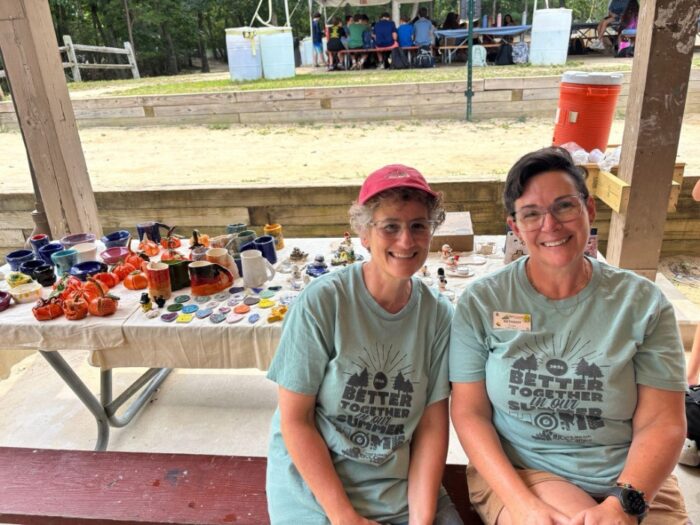
This is a story about a gift I received this summer. The people who gave me this gift thought they were receiving a gift from me. Both of these things are probably true. Let me tell you my version of the story, from the beginning.
In April, I received an email from Jared, the Director of the Roger and Jane Davis JCC Camps in Medford, NJ. The subject read: First Week – Possible Ceramics Help. He began by confirming that I would serve as Clergy-in-Residence during the first week of camp, as I did last year. Then came the unexpected request:
“With you being at camp the first week, I wanted to ask if you might be able to help us fill an unexpected void as a result of school year adjustments from the snow days this winter. Bethany, our Ceramics Specialist, is out most of that first week because her school year got extended. We are now seeking a ceramics specialist to sub in her place.”
He continued to explain that he knew I’d helped out last year, that I had experience as a ceramics specialist at another summer camp, and that other staff members, including Bethany, had recommended me to him, saying that I might be able to cover both handbuilding and wheel ceramics classes. His email concluded:
“I know it might be a big ask, but given your background, we would be so appreciative of any help you could give. Let me know your thoughts.”
My very first thought when I finished reading Jared’s email was: I can’t.
It had been nearly five years since I’d thrown on the wheel, longer since I’d taught ceramics at Camp Ramah Darom. Sure, I’d helped out last summer, washing tools and assisting campers with their handbuilding projects. Bethany was grateful for the extra pair of hands and graciously invited me to join her for lunch every day. The ceramics studio was my happy place at camp, and at home. I’d moved my wheel and the contents of my basement studio from Atlanta to New Jersey with the hope of returning to the clay when I’d completed physical therapy for spinal stenosis. But I hadn’t unpacked a single box in the ten months since they’d arrived, and my wheel and small wedging table sat untouched in the corner of the garage where the movers had left them.
To be honest, when I read the last lines of Jared’s message—before the words “I can’t” entered my mind—I cried.
I cried because I knew immediately, deep in my core, that I couldn’t do it.
I yearned to say “yes” but knew I had to say “no.”
The fear that my body at almost sixty would not be able to withstand the physical demands of this role had hardened to despair. I felt like I’d been sucker-punched. In truth, I’d sucker-punched myself.
* * * * * * *
The next morning, my despair had softened to disappointment. I put a note in my calendar to call Jared when I got to the office, and went about my morning rituals: solving the New York Times puzzles and reading My Jewish Learning’s Daf Yomi newsletter. It was a Friday morning, so I also read the Daily Dose of Talmud for Shabbat morning, which involved a complicated debate about the apparatus for displaying the showbread in the Temple.
As I read Rabbi Lexie Botzum’s article, a few sentences jumped out at me:
“Interestingly, it is Rava himself who resolves his own objection…” and “Though it isn’t common, we occasionally see such cases in the Gemara, where a rabbi states an opinion and then later recants it. Rava found a flaw in his own argument…”
I realized that I hadn’t approached my decision logically. So I began examining my kushyot (objections) to Jared’s proposal, to see if I could resolve them myself.
- How could I be unavailable to my congregants for five days the week before I left for a month-long vacation? (Answer: I wouldn’t be unavailable in the evenings…)
- Even if I could return phone calls in the afternoons and attend evening meetings, when would I prepare for Shabbat services? (Answer: I’d prepare as I do every week, in the evenings…)
- Even if I had the stamina to teach four or five 40-minute chuggim (classes) a day for five days, how could I also serve as Clergy-in-Residence AND lead Camp Shabbat on Friday?! (Answer: I couldn’t, but Jared would find another rabbi to lead Camp Shabbat…)
Like the fourth-century sage, Rava, I found flaws in my own arguments. Of course, it would be a busier than usual week, and I might find the physical challenges of the work more tiring at 59 than I did at 49. Still, I permitted my rational self to overrule my fear of failure as I recalled the wise advice of Eleanor Roosevelt: “We must do the things we think we cannot do.”
I replied to Jared’s email, accepting his invitation to discuss how this arrangement would work.
* * * * * * *
Jared arranged for me and Bethany, the ceramics specialist, to spend the Sunday afternoon of Staff Orientation together. We reviewed the schedule and curriculum for the handbuilding and wheel ceramics chuggim for week 1. We unpacked the clay and tools, identified all of the materials I’d need, each of us taking notes about what we’d bring from home. Then we set up the campers’ wheels and the teacher’s demo wheel. She admired my ergonomic Shimpo stool that I’d brought from home, and we commiserated about our respective back issues. Before leaving, we locked the supply closet and promised to text each other during the week.
The next Sunday, I returned with my toolbox and a beach towel, retrieved my stool from the supply closet, and sat down at the wheel to practice for the wheel ceramics demonstrations I would be required to do in week 1.
I was more than a little nervous as I recalled all of the kushyot I’d raised before agreeing to do this. My objections had not yet been completely resolved—I had not yet proven I could still throw—and the question of how my osteoarthritic body would hold up still loomed large.
Positioning my body as I prepared to center the clay, I remembered Liz, my first teacher, who in the fall of 2002 was just a little older than I am now. Liz spent a great deal of time teaching us about the importance of posture, lessons she’d learned from living with osteoarthritis. As I absorbed Liz’s lessons, I came to appreciate how good posture made mastering the mechanics of throwing easier.
Liz taught me that throwing on the wheel is an embodied practice. Over time, it also became a spiritual practice for me.
I began centering the clay and saying aloud the things I would say to the campers to describe what I was doing: to center the clay you have to be still and patient; remember to hold your two hands together and keep them steady, working in concert; they are the two most important tools you have…
As I was talking to myself, I began returning to myself. My mind attuned to my voice and my body relaxed, and I felt my spirit soar.
During the first week of camp, I would repeat this experience—demonstrating how to throw on the wheel—ten times. In my two Advanced Wheel chuggim, with campers who’d already learned how to throw, my role was to coach and encourage them while they created their own pieces.
Every morning when I picked up my binder in the office and every afternoon, as I was leaving, Jared would thank me for my help. Ten times I told him that I was grateful for the gift he’d given me, the opportunity to work at camp. To work in the clay.
* * * * * * *
On the last day of camp, I returned to help Bethany finish cleaning the wheels as I had promised I would. We’d kept in touch all summer, mostly by text, trying to figure out whether we could take a wheel class together in the fall at one of the local studios.
I helped some campers pack up their projects to take home, and I carried my stool, which Bethany had borrowed for the summer, back to my car. Later that afternoon, I’d take it out of the trunk and return it to the studio in my garage, where there is also a bag of clay waiting for me to return to the wheel.
On the last day of camp, Jared thanked me again, and I told him that the gifts I’d received, the return to the embodied and spiritual practice of throwing on the wheel, the return to my happy place at camp and at home, were gifts beyond measure.
I also told him about how I cried when I read his email four months ago, and that the greatest gift I received from him was his trust that I could do the things I thought I couldn’t do.